

Key takeaways
- Clay holds water after rain and cracks when dry. Organic matter and mulch smooth out those swings.
- Test drainage first, and raise beds a few inches wherever water lingers.
- Amend the whole bed, not just the planting hole, and never dig clay when it is wet.
- Set plants at or slightly above grade, and water by feel through the first season.
How Clay Behaves in Southwest Ohio Yards
Clay soil is made of very fine particles packed tightly together. That gives it real strengths, since it holds nutrients and moisture well. The trouble is that it holds water too well after rain, then dries into a hard, cracked crust in summer. Bare clay swings between those extremes. Roots get caught in the middle, short on air when the soil is soggy and short on water when it bakes.
If your yard in Liberty Township or elsewhere in southwest Ohio has heavy clay, hot summers make the dry side worse. Mean July highs here run around 87°F. The goal is not to replace clay but to give roots a better place to grow.
Test Drainage Before You Plant
A simple test tells you how much work a spot needs.
- Dig a hole about a foot deep and a foot wide where the bed will go.
- Fill it with water and let it drain completely.
- Fill it again and check it over the next several hours.
If the second fill drains steadily, you are in decent shape. If water is still sitting in the hole the next day, drainage is poor. You can raise the bed, choose plants that tolerate wet soil, or fix the cause, such as a downspout emptying into the area or grade that slopes toward the bed.
Check the grade around your house too. Foundation beds should slope gently away from the walls so water does not collect against them.
Improve the Whole Bed and Raise It Slightly
Organic matter is the single best thing you can add to clay. Compost and similar materials open up the soil, improve drainage and reduce the swing between wet and dry.
- Amend the entire bed. Spread organic matter over the whole bed and work it into the top several inches. If you fill only the planting hole with rich mix, you create a pocket that collects water. Roots then sit in a puddle and hesitate to grow into the surrounding clay.
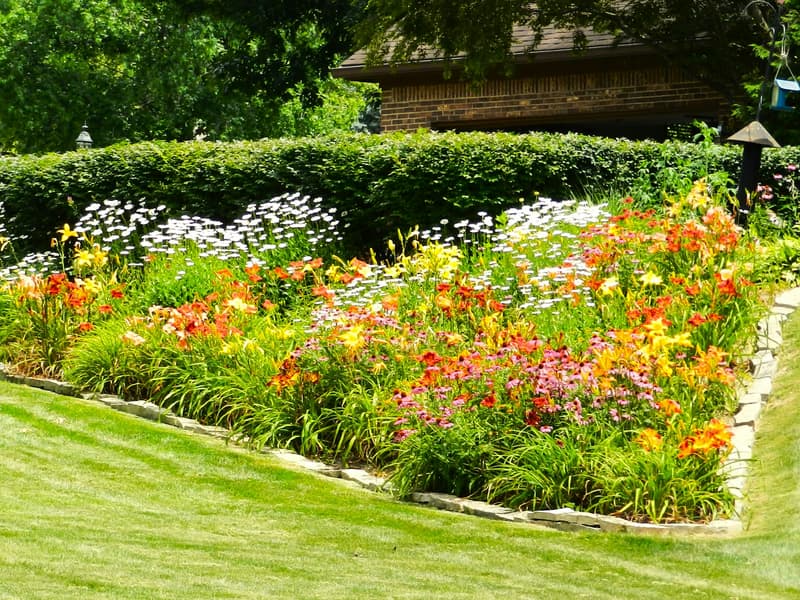
- Build up, not down. Raise the planting area a few inches above the surrounding grade, or shape a gentle berm. This keeps crowns and upper roots out of saturated soil. Taper the edges so the bed blends into the lawn.
- Dig only when the soil crumbles. Squeeze a handful. If it forms a sticky ribbon, wait. Digging wet clay smears it into dense clods.
- Skip the sand. Mixing small amounts of sand into clay can make it denser rather than lighter. Stick with organic matter.
- Mulch afterward and keep it refreshed. Mulch moderates soil temperature and moisture, and as it decays it keeps adding organic matter that builds soil structure.
Planting Depth: Set Plants High, Not Deep
Planting too deep is one of the most common reasons new trees and shrubs fail. Clay makes the problem worse, because the bottom of a deep hole stays wet.
- Dig the hole two to three times as wide as the root ball, but no deeper than the root ball is tall.
- Set the plant on firm, undisturbed soil so it does not sink after watering.
- Keep the top of the root ball at or slightly above the surrounding grade. On trees, the root flare, where the trunk widens at the base, should be visible.
- Loosen or tease apart circling roots on container plants so they grow outward.
- Backfill with the soil you removed, blended with the same organic matter you used across the bed. Firm it gently to remove large air pockets.
The idea is for roots to find similar conditions inside and outside the hole, so they keep growing outward instead of circling.
Watering New Plantings in Clay
New plantings in clay need a different watering rhythm than plants in looser soil.
- Water thoroughly at planting to settle the soil around the roots.
- Check before you water. Push a finger or trowel a couple of inches down next to the root ball, and water only when it feels dry. The root ball can dry out faster than the clay around it, so check right at the base of the plant.
- Water deeply and slowly. A slow trickle at the base soaks in, while a fast blast runs off hard clay.
- Adjust for the weather. Water more in summer heat and less in cool, wet spells. Keep an eye on new plants through their first full growing season.
- Mulch 2 to 3 inches deep with hardwood bark, pulled away from stems and trunk flares and never mounded against them. Our guide on mulch depth explains why.
For bed layout and plant layering, see the landscape bed design and installation guide. If you would rather have the bed built for you, Barefoot Landscaping offers landscape bed design and installation and mulch installation in Liberty Township, Monroe and West Chester.
Frequently asked questions
Can I just spread new soil on top of my clay?
A few inches of good soil blended with organic matter can help raise a bed. Mix the bottom of that layer into the clay so there is no sharp boundary for water and roots to cross. Over the long run, ongoing mulch and organic matter matter more than a one-time cap.
How do I know if I am overwatering plants in clay?
If the soil a couple of inches down is still damp, the plant does not need water yet. Wilting or yellowing leaves on plants sitting in wet soil can mean the roots are short on air, which is common in clay.
Do I always need a raised bed in clay?
No. Where a drainage test shows water draining steadily, an amended bed at grade works fine. Raising the bed matters most in spots where water sits for a day or more after rain.